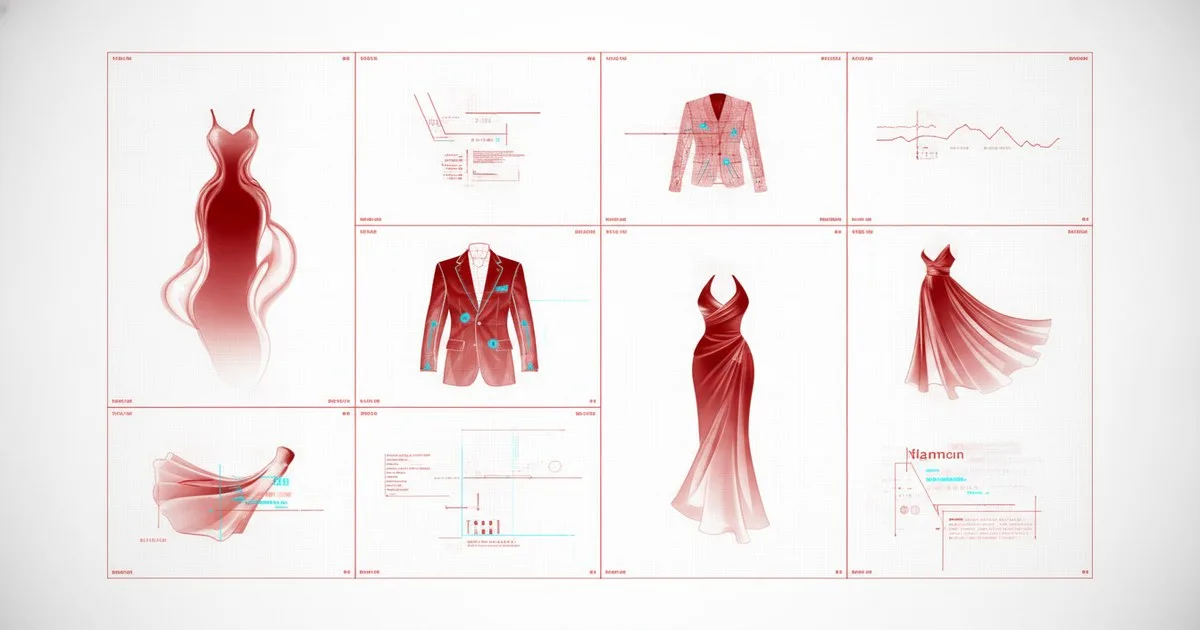
AI trend forecasting uses image recognition and social signal analysis to predict consumer demand, but it cannot replace a merchant’s understanding of price elasticity or macroeconomic shifts. While platforms can now identify thousands of visual attributes with high accuracy, the gap between a "liked" image and a completed transaction remains the industry's primary challenge. To succeed, buying and planning teams must treat AI as a signal of visual interest rather than a guaranteed purchase order.
Key takeaways
- Time-to-market in fashion has accelerated by nearly 30% over the last decade, making real-time data essential for survival.
- Social media engagement measures aspiration, which often diverges from the actual spending power of consumers.
- AI platforms like Heuritech (now part of the Luxurynsight Group) analyze over 2,000 visual attributes to forecast trends up to 24 months in advance.
- High-accuracy visual predictions—claimed at 92% by Luxurynsight—do not account for internal inventory constraints or logistical delays.
- Effective merchandising requires connecting trend signals to inventory tools like Style Arcade to manage size curves and margins.
How does AI trend forecasting actually work?
You are no longer relying on a single creative director’s intuition or a trip to a trade show. Modern forecasting is a high-speed data operation. The process begins with massive ingestion: AI systems crawl millions of public social media images daily, stripping away the noise to focus on the product.
Heuritech, which joined the Luxurynsight Group in late 2024, uses computer vision to identify specific attributes—think sleeve length, pantone shades, fabric textures, and collar shapes. This isn't just about spotting a "vibe"; it is about quantifying the frequency of 2,000 distinct details across different geographies and consumer segments. By tracking how these attributes move from early adopters to the mass market, the system builds a mathematical model of a trend's lifecycle.
This shift aims to turn volatile demand into predictable patterns. Instead of designing a collection based on what sold last year, you are designing based on what is gaining momentum on the street today. However, the data is only as good as the images it sees. If a trend is bubbling in private communities or offline subcultures, it may remain invisible to the AI until it hits the mainstream.
Why do social signals often diverge from sell-through?
You see a lime green blazer go viral on Instagram. Your AI dashboard shows a 40% increase in visibility. You double your buy. Three months later, you are looking at a 60% markdown. What happened?
The "aspiration-action gap" is the most dangerous blind spot in fashion tech. Social media measures what people want to be seen liking, not necessarily what they are willing to open their wallets for. This is particularly true in a tightening economy. For instance, as of May 28, 2026, US consumer sentiment has weakened, with a pronounced pullback in discretionary spending among low-income brackets.
AI can tell you that a trend is visually dominant, but it cannot tell you if your specific customer has the disposable income to buy it. If your forecasting tool isn't layered with macroeconomic data—like the research found in the McKinsey State of Fashion reports—you are only seeing half the picture. You might be tracking a trend that is "cool" but price-prohibitive for your target demographic.
What are the limits of "92% accuracy" claims?
When a platform claims 92% accuracy, you need to ask: accuracy of what? Usually, this refers to the system’s ability to predict whether a visual attribute will increase or decrease in social media prevalence over a specific period. It is a measure of visual momentum, not a guarantee of SKU-level sales.
Accuracy in forecasting is often broken down by market and consumer profile. A trend might have 95% predictability in the luxury segment in Paris but only 60% in the mid-market in the US Midwest. Furthermore, these models are often built on historical social data. They struggle with "Black Swan" events—sudden geopolitical shifts, celebrity scandals, or rapid changes in trade policy—that can render a trend obsolete overnight.
How should buying and planning teams use this data?
To move from "guessing" to "planning," you must integrate trend signals with your actual retail operations. AI trend data tells you what to design; merchandising analytics tell you how much to buy.
For example, tools like Style Arcade, which secured a Series A in late 2022, focus on the "math" of the assortment—size curves, margin protection, and inventory health. The most successful brands use a three-step workflow:
- Signal Detection: Use Luxurynsight’s Heuritech data to identify which silhouettes and colors are accelerating.
- Contextual Overlay: Filter those signals through current consumer sentiment data to adjust for price sensitivity.
- Operational Execution: Use a merchandising workspace to determine the depth of the buy based on historical size-curve performance and current stock levels.
Without this integration, you risk overproducing "trendy" items that don't fit your customer's body type or budget, leading to the very deadstock and uncertainty that demand forecasting is supposed to reduce.
Comparing Forecasting Approaches
| Data Source | Best For | The Blind Spot |
|---|---|---|
| Social Image AI | Early detection of visual aesthetics and "vibes" | High noise; engagement does not equal purchase intent |
| Search Data | Quantifying active consumer intent for a category | Reactive; often too late for long-lead production cycles |
| Merchandising Analytics | Optimizing size curves and protecting margins | Backward-looking; misses new style shifts |
| Human Expertise | Final decision-making and brand alignment | Subject to personal bias and limited scale |
What can go wrong when you over-rely on AI?
The biggest risk is the homogenization of fashion. If every brand uses the same AI tools to crawl the same social media data, every brand ends up producing the same lime green blazer. This creates a "race to the bottom" on price, as the products become indistinguishable.
Additionally, AI cannot understand brand DNA. A trend might be massive globally, but if it contradicts your brand’s core identity, adopting it will alienate your loyal customers. As Léa Gossein and Noémie Voyer noted in recent industry discussions, the future of fashion lies in the synergy between AI and human expertise. The AI provides the data points; the human provides the curation and the "why."
FAQ
Can AI predict a trend 24 months in advance? Yes, by analyzing the movement of attributes from high-end runway shows and early-adopter social circles, platforms like Heuritech can model the likely adoption curve for the mass market up to two years out. However, the further out the forecast, the higher the risk of disruption from external economic factors.
Why does viral social media engagement fail to translate to sales? Viral content often represents "digital window shopping." A consumer may like an image because it is visually striking or aspirational, but they may lack the occasion, the confidence, or the funds to actually wear the garment. AI measures the image's popularity, not the consumer's wallet.
Is AI trend forecasting only for luxury brands? No. While Luxurynsight focuses on the luxury and beauty sectors, the technology is increasingly used by fast-fashion and mid-market retailers to reduce lead times and minimize overproduction. For these brands, the goal is often inventory efficiency rather than just trend-setting.
How does AI help with sustainability in fashion? By providing more accurate demand signals, AI helps brands avoid overproduction. When a brand knows exactly which colors and styles are declining in popularity, they can cut production orders early, preventing the creation of deadstock that would otherwise end up in landfills or on deep-discount racks.
What is the difference between search data and social signal data? Search data (like Google Trends) shows active intent—people looking for something they likely want to buy now. Social signal data (image recognition) shows emerging aesthetics—things people are looking at but haven't necessarily decided to buy yet. Social signals are better for long-term design; search data is better for short-term stock replenishment.
Further reading
- Fashion Inventory Forecasting: Reduce Uncertainty with AI
- The State of the US Consumer - May 2026
- Style Arcade
- Luxurynsight