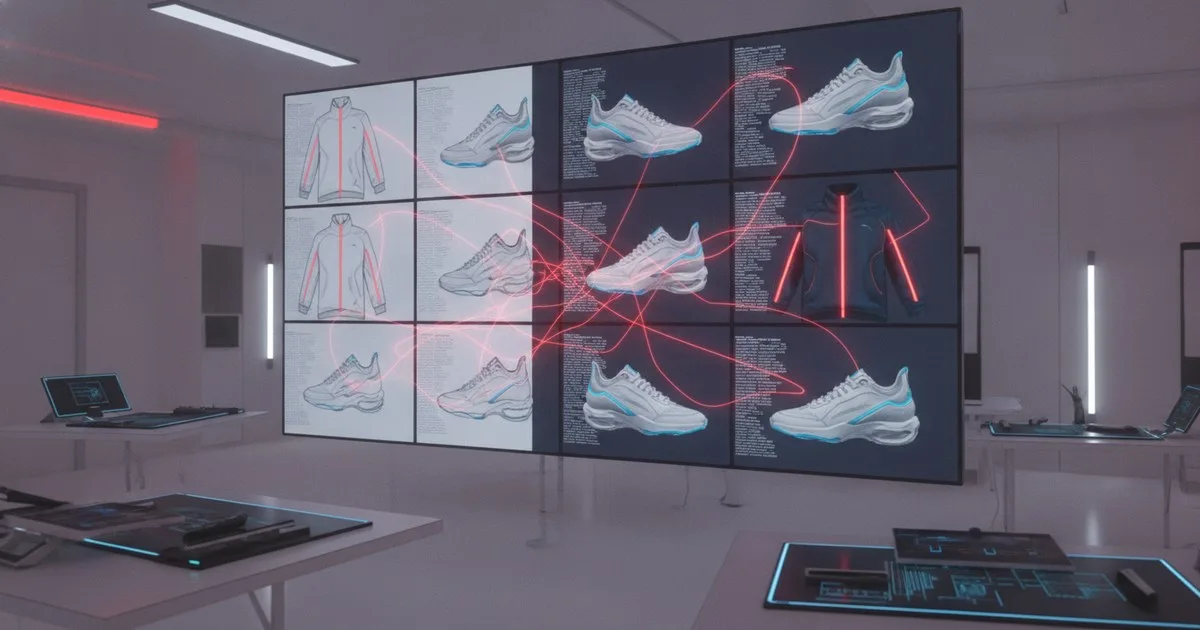
Choosing an AI design platform requires looking past the aesthetic output and interrogating the underlying data rights, technical integration, and manufacturability of the results. For design directors, the priority is no longer just "generating ideas" but finding tools that respect brand heritage and bridge the gap between a 2D render and a technical specification. This guide compares four dominant platforms and two critical strategic approaches to help you decide where to pilot your next creative cycle.
Key takeaways
- Fashion-specific platforms like Raspberry AI and Refabric offer superior control over garment silhouettes compared to general-purpose image generators.
- Adobe Firefly remains the safest choice for commercial IP protection, as it is trained exclusively on licensed and public domain content.
- The primary bottleneck for AI adoption is the lack of direct "AI-to-Pattern" export, requiring manual translation by skilled technical designers.
- Design teams are increasingly moving toward "Proprietary Brand Engines" to ensure visual consistency across seasonal collections.
How do Raspberry AI and Refabric handle fashion-specific constraints?
General AI tools often struggle with the physics of clothing—how a seam sits on a shoulder or how a specific knit texture drapes. Raspberry AI addresses this by focusing on the intersection of creative ideation and retail-ready output. It allows design teams to maintain control over specific garment attributes, ensuring that the generated designs aren't just beautiful pictures, but concepts that can actually be developed into physical products. This is critical for creative operations leads who need to reduce the time spent on unfeasible concepts.
Similarly, Refabric provides an AI-driven workspace specifically tailored for the fashion industry. It moves beyond simple text-to-image prompts by incorporating design-centric features that allow for more granular manipulation of styles and textures. In our analysis of the platform, the advantage lies in its ability to understand fashion terminology and silhouettes better than a generic model. This reduces the "prompt fatigue" often experienced by designers trying to explain a specific "raglan sleeve" or "asymmetrical hem" to an AI that was trained mostly on internet cat photos and landscapes.
Can Midjourney and Adobe Firefly be used for professional garment design?
You likely already have designers experimenting with Midjourney. Its output is arguably the most visually stunning in the industry, capable of hyper-realistic textures and avant-garde silhouettes. However, for a professional design studio, it presents two major hurdles: a lack of precise control and a public-by-default environment (unless you pay for the Pro plan's stealth mode). You cannot easily tell Midjourney to "keep the collar but change the buttons"; it tends to regenerate the entire image, making iterative design a frustrating process.
Adobe Firefly takes a different approach. While its creative "flair" may sometimes feel more conservative than Midjourney, it is built for the enterprise. Its primary selling point is commercial safety. Because it is trained on Adobe Stock and public domain images, your legal department won't block its use. Furthermore, its integration into the Creative Cloud means designers can use AI-generated textures or elements directly within their existing Photoshop or Illustrator workflows. For design directors, this represents a lower barrier to entry for team-wide adoption.
What are the IP and ownership risks for design directors?
Intellectual property remains the "wild west" of fashion technology. When you use a tool like Midjourney, the US Copyright Office has currently signaled that AI-generated images without significant human intervention cannot be copyrighted. This creates a risk for brands: if you generate a flagship print or a unique silhouette using a public AI, you may not be able to stop a fast-fashion competitor from copying it exactly.
Platform-specific terms of service are your first line of defense. Some platforms claim no ownership over your inputs or outputs, but the legal reality of the training data persists. As noted in recent educational forums, such as the open house at EPCC on February 28, 2025, the fashion tech program highlights that the industry is increasingly a blend of art, math, and engineering. This engineering side includes the data architecture. If your AI tool is "learning" from your proprietary sketches to improve its general model, you are effectively leaking your brand’s DNA to the platform’s other users.
How do these tools integrate with existing CAD and technical workflows?
The industry is still searching for the "holy grail": an AI that outputs a production-ready tech pack. Currently, most platforms produce a flat 2D image. The translation of that image into a 3D model or a 2D pattern still requires a human expert—a modellista or technical designer.
However, the workflow is shifting. Designers are now using AI to generate high-fidelity "render-like" images to get executive buy-in before starting the expensive sampling process. This "AI-first" approach can cut weeks off the initial ideation phase. The challenge remains the hand-off. Without a direct export to standard industry formats (.DXF or .ZPRJ), the AI tool remains a siloed part of the creative process rather than a fully integrated member of the PLM (Product Lifecycle Management) chain.
Which pricing model fits a high-volume design studio?
| Platform / Methodology | Best For | Limits |
|---|---|---|
| Raspberry AI | Professional fashion ideation and manufacturability. | Higher entry cost for small teams. |
| Refabric | Creative workspace and style manipulation. | Requires learning a specific AI-fashion interface. |
| Midjourney | High-fidelity aesthetic inspiration and moodboarding. | Minimal technical control; IP legal gray areas. |
| Adobe Firefly | Commercial safety and Creative Cloud integration. | Output can be less "creative" than specialized models. |
| Custom In-House Engines | Protecting brand DNA and archival consistency. | Significant upfront investment in GPU and data science. |
| Open-Source Frameworks | Maximum flexibility and local data hosting. | Requires dedicated IT/DevOps support to maintain. |
How to pilot an AI design tool in your studio
If you are ready to move beyond the "toy" phase, follow these four steps to implement a professional AI design pilot:
- Define the Use Case: Do not try to automate everything. Start with either "Moodboarding" or "Print/Pattern Generation." These are the lowest-risk areas with the highest immediate return on time.
- Audit the Data Rights: Before uploading any archival sketches to a platform, ensure the contract includes a "private tenant" or "no-training" clause. Your brand's history is its value; don't give it away for a $30/month subscription.
- Establish a Prompt Library: Professional design requires repeatable results. Create a shared document of "Brand Prompts" that define your specific fits, fabrics, and colors to ensure consistency across different designers.
- Measure the "Time to Sample": The only metric that matters for creative operations is whether AI reduces the time from initial concept to the first physical or 3D sample. If the AI output is so unrealistic that it takes the technical team longer to interpret it, the tool is a failure.
FAQ
Can AI generate a production-ready tech pack?
Currently, no. Most AI design platforms generate 2D visual representations. While some fashion-specific tools are beginning to offer automated measurement estimations, a human technical designer is still required to create the final tech pack and grading for production.
Is it legal to use AI-generated designs for commercial sales?
It depends on the platform. Tools like Adobe Firefly are designed for commercial safety. However, the copyrightability of the resulting design is still a matter of active legal debate in many jurisdictions. Always consult your legal team regarding "substantial human transformation" of AI outputs.
Do I need a GPU or high-end computer to run these platforms?
Most leading platforms like Refabric and Raspberry AI are cloud-based, meaning the heavy processing happens on their servers. You only need a standard professional laptop and a stable internet connection to access their web-based interfaces.
How does AI handle specific fabric textures like knitwear or lace?
General models often produce "hallucinated" textures that look good but cannot be woven. Fashion-specific platforms are better at recognizing knit structures, but the most accurate results come from uploading your own high-resolution fabric scans as a reference for the AI to apply.
Further reading
- CLO | 3D Fashion Design Software
- Interior Design, Fashion Tech Hold Open House for Students - EPCC
- Raspberry AI
- Browzwear
- Marvelous Designer
- Refabric
- Midjourney
- Optitex
- Adobe Firefly