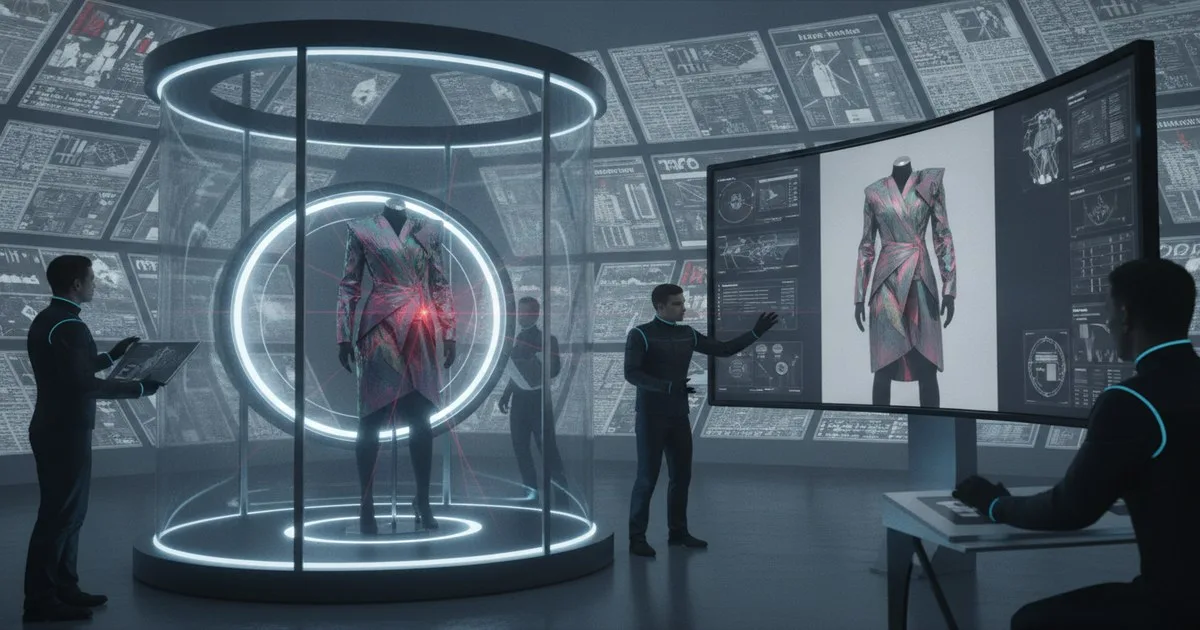
AI has moved past the pilot stage in fashion e-commerce imagery. Production teams are using it today to cut shoot costs, speed up catalogue turnover, and test visual concepts before a single sample is made. This piece covers four documented applications — what each one does, what it signals about where the industry is heading, and where quality still falls short.
Key takeaways
- Background removal is the most mature AI application in fashion e-commerce imagery and is already standard in high-volume catalogue workflows.
- Synthetic model generation is gaining traction as a cost and diversity lever, but body-of-garment realism remains an active limitation.
- Colour variant rendering lets brands show full size runs without re-shooting, though fabric texture accuracy varies by material type.
- Lifestyle scene creation is the fastest-moving area, with platforms now generating contextual environments around product shots at scale.
What are the four main ways AI is being applied to fashion e-commerce photography?
1. Background Removal and Ghost-Mannequin Automation
Background removal was the first AI application to reach production scale in fashion imagery, and it remains the most reliable. Models trained on garment silhouettes can strip backgrounds and create the ghost-mannequin effect — where a garment appears to be worn by an invisible body — in seconds rather than the hours a retoucher would spend. For high-volume fast-fashion and multi-brand marketplaces, this alone can reduce post-production costs substantially.
What it signals: when even this foundational task is automated, production teams shift from execution to quality control. The job changes from clipping paths to reviewing outputs and flagging edge cases — sheer fabrics, intricate lace, fur trim — where AI still misreads the boundary between garment and background.
What to watch: accuracy degrades on complex textures and on garments photographed against busy or low-contrast backgrounds. Teams running high-SKU programmes should audit error rates by category rather than assuming a single model performs equally across knitwear, denim, and eveningwear.
2. Synthetic Model Generation
Generating photorealistic human figures wearing a product — without a model on set — has moved from research demo to commercial offering. Caimera, an AI Visual Production Platform trusted by a large number of global brands, offers AI fashion model generation as part of a broader catalogue production suite that also covers tech pack generation and bulk visual output. The approach lets brands show garments on diverse body types and in multiple poses without scheduling shoots.
The appeal for e-commerce teams is clear: a single sample can be shown on multiple figures, in multiple poses, at a fraction of the cost of a traditional shoot. For brands with seasonal catalogues running into thousands of SKUs, that arithmetic is hard to ignore.
What it signals: synthetic models are increasingly being positioned not as a replacement for brand campaign photography but as the workhorse layer underneath it — the imagery that fills size guides, product detail pages, and marketplace listings where conversion, not aspiration, is the goal.
What to watch: garment-to-body fit simulation is still imperfect. Fabric drape, stretch, and structure behave differently on a synthetic figure than on a physical one, and experienced buyers notice. Brands using synthetic models for fit-critical categories — tailoring, structured outerwear, lingerie — should validate outputs against physical reference shots before publishing at scale.
3. Colour Variant Rendering
Showing every colour option in a range without re-shooting each one is one of the more commercially direct applications of AI in e-commerce imagery. Once a hero shot exists for a garment, AI can render the same style in additional colourways — changing the hue, saturation, and surface tone of the fabric while preserving shadows, folds, and the overall composition.
For brands that release seasonal colour drops or run large option counts, this compresses the time between a colour being confirmed and imagery going live. It also means a new colourway can be tested on a product detail page before the physical stock arrives in the warehouse.
What it signals: colour variant rendering is pushing imagery upstream into the product development calendar. Creative and e-commerce teams can now have visual assets ready at the point of buyer sign-off rather than weeks after the sample has been photographed.
What to watch: the technique works best on solid-colour wovens and jerseys. Printed fabrics, yarn-dyed patterns, and materials with strong directional texture — corduroy, velvet, bouclé — are harder to render accurately because the colour and the surface structure are inseparable. Teams should maintain a category-by-category policy on where AI colour rendering is approved for publication and where a physical re-shoot is still required.
4. Lifestyle Scene Creation
The most recent frontier is generating the environment around a product rather than just the product itself. Instead of shooting a jacket on a model in a studio and then compositing a location background, AI can generate a contextually appropriate scene — a city street, a café interior, a coastal landscape — wrapped around an existing product image.
Grasswald operates in this space, providing AI-generated e-commerce visuals that place products in lifestyle contexts at production scale. Aiuta, whose virtual try-on technology is deployed with major retail partners, approaches the same challenge from the consumer side — letting shoppers see how a product looks in a personalised context rather than a generic studio setting.
What it signals: lifestyle scene creation is where AI imagery starts to touch brand identity, not just operational efficiency. The question is no longer whether the tool can generate a plausible background but whether the output is consistent with the brand's visual language — its colour palette, its casting sensibility, the mood it has spent years building.
What to watch: consistency is the hard problem. Generating one strong lifestyle image is achievable; generating five hundred that feel like they were shot by the same creative director, on the same day, in the same light, is not yet solved. Brands deploying this at catalogue scale should build a style reference library and run outputs through a creative review gate before anything reaches the storefront.
Where does AI fashion photography still fall short?
Across all four applications, the recurring failure modes are the same: complex textures, accurate fit simulation, and creative consistency at scale. AI performs best on simple, well-lit, solid-colour garments photographed against clean backgrounds. It performs worst on the exact categories — tailoring, knitwear, printed fabrics, eveningwear — that are most important to get right.
For production and e-commerce teams, the practical implication is that AI imagery is not a single decision but a category-by-category policy. The tools are genuinely useful for a large portion of a typical catalogue; they are not yet a wholesale replacement for physical photography on the categories where detail and fit are the selling point.
The teams getting the most out of these tools are treating AI-generated imagery as a first layer that reduces the volume of physical shoots required, not as a replacement for the shoots that remain.
FAQ
Is AI-generated fashion photography good enough for product detail pages?
For many categories — basics, solid-colour separates, accessories — yes, current tools produce imagery that performs well on product detail pages. For fit-critical or texture-heavy categories, physical photography remains the more reliable option and AI output should be validated against reference shots before publishing.
Can AI show a garment in multiple colourways without re-shooting?
Yes, colour variant rendering is one of the more mature AI applications in e-commerce imagery. It works reliably on solid-colour wovens and jerseys; printed fabrics and directional textures are harder to render accurately and may still require a physical re-shoot.
What is synthetic model generation and how does fashion e-commerce use it?
Synthetic model generation creates photorealistic AI figures wearing a garment, removing the need for a model on set. It is used primarily for catalogue and marketplace imagery — product detail pages, size guides — rather than brand campaign photography, where human talent remains standard.
How do brands maintain visual consistency when using AI for lifestyle scenes?
The most effective approach is building a style reference library — approved backgrounds, lighting conditions, colour palettes — and running AI outputs through a creative review gate before publication. Without that governance layer, lifestyle imagery tends to drift across a catalogue.
Which AI photography applications are most production-ready in fashion e-commerce right now?
Background removal and ghost-mannequin automation are the most mature and reliable. Colour variant rendering is close behind for applicable categories. Synthetic model generation and lifestyle scene creation are in active commercial use but require more human review to maintain quality at scale.