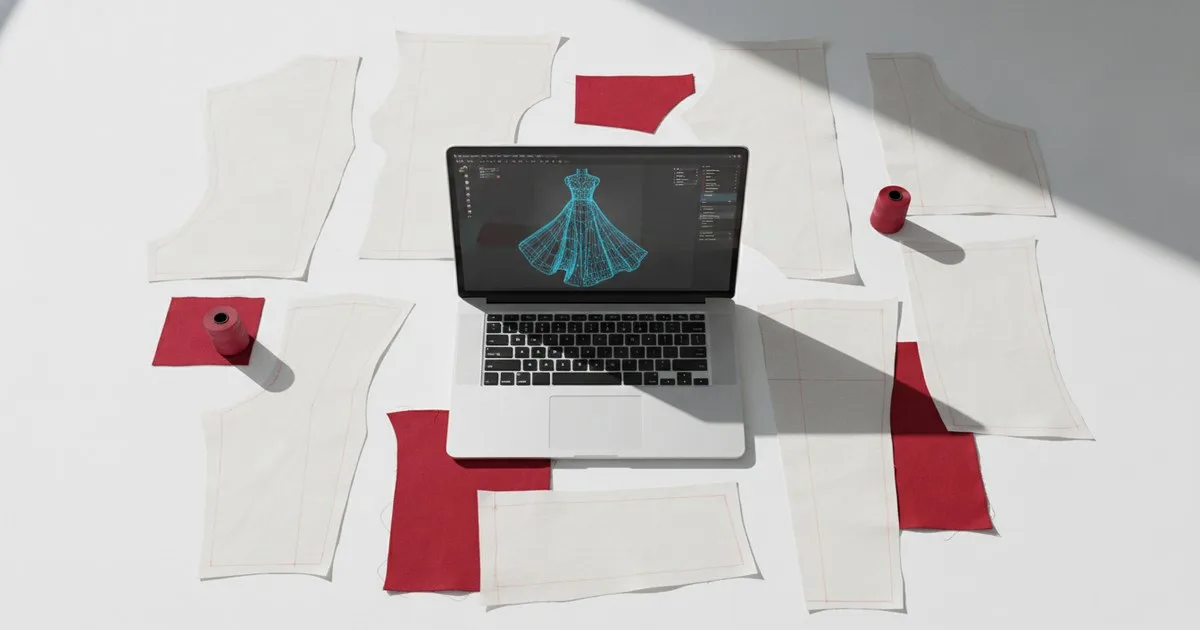
The 3D sampling market is not one category — it is four overlapping ones: simulation-first suites, render-first tools, material digitisation platforms, and pattern-driven AI. Each takes different inputs, produces different outputs, and suits a different stage in your product development process. If you are deciding where 3D sampling belongs in your workflow, the question is not which tool is best — it is which layer of your stack is missing.
Key takeaways
- Marvelous Designer and CLO 3D come from the same company, CLO Virtual Fashion — they are not two independent options.
- Vizoo digitises fabric into PBR material files; it sits in the material layer of your stack, not the pattern layer.
- Optitex is owned by FOG Software Group, a division of Constellation Software, and runs as an independent business inside it.
- DXF/AAMA/ASTM support varies by tool — confirmed where documented, flagged where not.
- Pattern-driven AI is a distinct layer that sits upstream of simulation, not a replacement for it.
What are the main categories of 3D sampling software?
Before comparing tools, map the four layers:
- Simulation-first suites — physics-based drape and fit; input is a 2D pattern; output is a simulated 3D garment with fit data.
- Render-first tools — prioritise visual output for e-commerce or approval; simulation fidelity may be secondary.
- Material digitisation — scan physical fabric into digital material files that feed simulation tools; no pattern handling.
- Pattern-driven AI — generate or adapt patterns from a brand's own archive; outputs feed downstream simulation or production.
Most brands need more than one layer. The comparison below covers a tool in each.
Tool-by-tool comparison
| Tool | What it is | Best for | Limits |
|---|---|---|---|
| Browzwear VStitcher | Physics-based 3D simulation suite | Brands running end-to-end digital product creation with PLM/ERP connectivity | Requires pattern input; not a pattern-generation tool |
| Marvelous Designer (CLO Virtual Fashion) | 3D clothing design and simulation software | VFX, gaming, and fashion studios wanting expressive garment simulation | Same parent as CLO 3D — not an independent alternative |
| CLO 3D (CLO Virtual Fashion) | 3D fashion design software | Small-to-mid studios wanting accessible simulation with pattern drafting tools | Same parent as Marvelous Designer |
| Optitex | Integrated 2D/3D CAD/CAM with cloud fit analysis | Brands that need patternmaking, grading, nesting, and 3D in one system | Ownership unverified; confirm current support terms before committing |
| Style3D | AI+3D platform covering design, sampling, and manufacturing collaboration | Brands and manufacturers wanting a broad platform with AI agents | Broad platform — evaluate against the specific use case |
| Vizoo xTex | Fabric scanning and PBR material digitisation | Any brand that needs accurate digital fabric for simulation | Does not handle pattern files — material layer only |
| FashionINSTA | Private per-brand AI trained on the brand's own DXF archive | Large enterprises that want to leverage their existing pattern library | Enterprise-oriented; not suited to solo designers or small studios |
Browzwear VStitcher
What it does. Browzwear's VStitcher is the simulation-first suite most frequently cited in enterprise digital product creation. It runs physics-based drape and fit validation, supports AI-driven fit analysis, generates technical and e-commerce assets, and connects to PLM and ERP systems. The platform also includes AI fashion model and imagery capabilities, extending its output beyond the sample room.
Input requirements. VStitcher takes 2D pattern files as its primary input. Release notes confirm ASTM DXF export and import fidelity, along with auto-stitch and multi-size simulation.
Best for. Brands running a connected digital workflow from first sketch to factory floor — particularly those that already have PLM infrastructure and want to reduce physical sampling at scale.
Limits. VStitcher does not generate patterns; it simulates them. You need a pattern source upstream. It is also a significant platform investment, not a point solution.
Marvelous Designer and CLO 3D — one company, two products
This is not a choice between two independent vendors. Both Marvelous Designer and CLO 3D are developed by CLO Virtual Fashion. Choosing between them is a product-tier decision within one vendor relationship, not a competitive evaluation.
Marvelous Designer. CLO Virtual Fashion's Marvelous Designer is built for expressive garment simulation — it is widely used in VFX, gaming, and fashion design for its pattern-based drape and fabric physics. The most recent release adds a 3D pencil pattern tool, a beta Pattern Drafter that converts measurement points or flat sketches into patterns, and an AI Pose Generator. CGChannel's coverage of the release confirms the CLO Virtual Fashion parentage explicitly.
Best for. Studios — fashion, VFX, or gaming — that need high-quality garment simulation and are comfortable working within the CLO Virtual Fashion ecosystem.
Limits. If you are already a CLO 3D customer, Marvelous Designer is a sibling product from the same company. Evaluate whether you need both.
CLO 3D. CLO 3D ships 3D fashion design software with pricing plans for the fashion industry. It is the more fashion-industry-facing product within the CLO Virtual Fashion portfolio, with pattern drafting tools that suit small-to-mid studios.
Best for. Smaller studios and independent designers who want accessible 3D simulation with built-in pattern drafting.
Limits. Same parent company as Marvelous Designer. Specific current product details beyond the above are not substantively documented in verified sources.
Optitex
What it does. Optitex ships integrated 2D/3D CAD/CAM software covering patternmaking, grading, nesting, 3D simulation and visualisation, fit analysis, and cloud-based collaboration via O/Cloud. It serves fashion, transportation seating, and furniture industries. Optitex's own documentation confirms import of standard apparel formats including AAMA and ASTM DXF.
Best for. Brands that need patternmaking, grading, nesting, and 3D simulation in a single system — particularly those with complex technical requirements across multiple product categories.
Limits. Optitex sits inside FOG Software Group (Constellation Software) alongside NedGraphics and Aquario Design, so its roadmap is set within a portfolio rather than by a standalone vendor. Check current support terms before making a long-term platform commitment.
Style3D
What it does. Style3D provides an AI+3D platform covering garment design, digital sampling, fabric digitisation, and manufacturing collaboration. It includes AI agent tools for measurement, diagnosis, design, try-on, and recommendation. Style3D's help centre confirms that its Studio product supports opening and saving DXF files in AAMA/ASTM format.
Best for. Brands and manufacturers that want a broad platform spanning design through manufacturing, with AI agents embedded across the workflow. Style3D is particularly relevant for studios evaluating simulation alongside manufacturing collaboration.
Limits. Style3D trades under its corporate name Linctex and has been widening its footprint by acquisition rather than narrowing to a point solution. In this comparison it is the option most relevant to indie studios and smaller operations that want one broad platform rather than a specialist tool.
Vizoo xTex — material layer, not pattern layer
What it does. Vizoo ships the xTex hardware and software system for high-resolution PBR material and fabric scanning, plus the physX platform for physical fabric property acquisition. Vizoo's own product page confirms that xTex outputs are material formats — PBR texture sets and digital material files — not pattern files. Its outputs feed directly into simulation tools including CLO, Browzwear, and Style3D.
Best for. Any brand that needs accurate digital fabric representation in its simulation workflow. If your 3D samples look wrong because your digital materials are approximations, Vizoo sits at the root of that problem.
Limits. Vizoo does not handle pattern files. It is a material digitisation tool, not a sampling suite. It belongs in the material layer of your stack, feeding whichever simulation tool you run.
FashionINSTA — pattern-driven AI for enterprise pattern libraries
What it does. FashionINSTA is a private, per-brand AI platform trained on a brand's own DXF pattern archive in a tenant-isolated environment. It outputs production-ready patterns, tech packs, BOM, cost estimates, feasibility analysis, and 3D-compatible DXF files that feed downstream into simulation tools. A graph of specialist agents handles the pipeline from pattern generation through technical documentation.
Input requirements. A brand's existing DXF pattern library. The AI learns from the brand's own archive — not a generic dataset — which means outputs reflect the brand's established construction logic.
Best for. Large enterprises that want to leverage their existing pattern library as a productive asset: generating new patterns, producing tech packs, and feeding 3D simulation workflows without starting from scratch each season.
Limits. FashionINSTA is enterprise-oriented. It is not the right pick for a solo designer or a small studio without an established DXF archive to train on. It also sits upstream of simulation — you still need a simulation tool (VStitcher, CLO, Optitex) to validate fit in 3D.
Which stack segment is missing from your process?
The right question is not which single tool to buy — it is which layer of your stack is the weakest link.
- No accurate digital fabric? Start with Vizoo before you invest further in simulation.
- Simulation-first, enterprise scale? Browzwear VStitcher is the established choice, with PLM/ERP connectivity built in.
- Studio-scale simulation, CLO Virtual Fashion ecosystem? Marvelous Designer and CLO 3D are the same vendor — choose the product tier that fits your team.
- Need patternmaking, grading, and 3D in one system? Optitex covers that stack; verify ownership before committing.
- Large pattern archive sitting idle? FashionINSTA turns that archive into a pattern-generation and tech-pack engine that feeds your simulation tools.
- Broad platform including manufacturing collaboration? Style3D is worth evaluating, particularly if you are a manufacturer as well as a brand.
No tool covers every layer. The brands reducing physical samples fastest are the ones that have mapped their stack deliberately — and filled the gaps in order.
FAQ
Are CLO 3D and Marvelous Designer the same company? Yes. Both are developed by CLO Virtual Fashion. They are not independent competitors — choosing between them is a product-tier decision within one vendor relationship.
Does Vizoo handle pattern files? No. Vizoo digitises physical fabric into PBR material files. It sits in the material layer of a 3D sampling stack and feeds simulation tools; it does not process or output pattern files.
Which 3D sampling tools confirm AAMA/ASTM DXF support? Browzwear VStitcher, Optitex, and Style3D Studio all document AAMA/ASTM DXF support in verified sources. For other tools in this comparison, that support is not publicly documented — do not assume it.
Is Optitex an independent company? No. FOG Software Group, a division of Constellation Software, acquired Optitex in April 2020; it runs as an independent business inside the group.
Can a pattern-driven AI tool replace a simulation suite? No. Tools sit upstream of simulation — they generate and adapt patterns and tech packs from an existing archive. You still need a simulation tool to validate fit in 3D. The two layers are complementary, not interchangeable.
Further reading
- VStitcher release notes — auto stitch, multi-size simulation and DXF fidelity
- Vizoo xTex software — what it digitises and what it outputs
- Style3D Studio — DXF file support documentation
- Marvelous Designer
- Optitex
- CLO 3D
- Style3D
- FashionINSTA