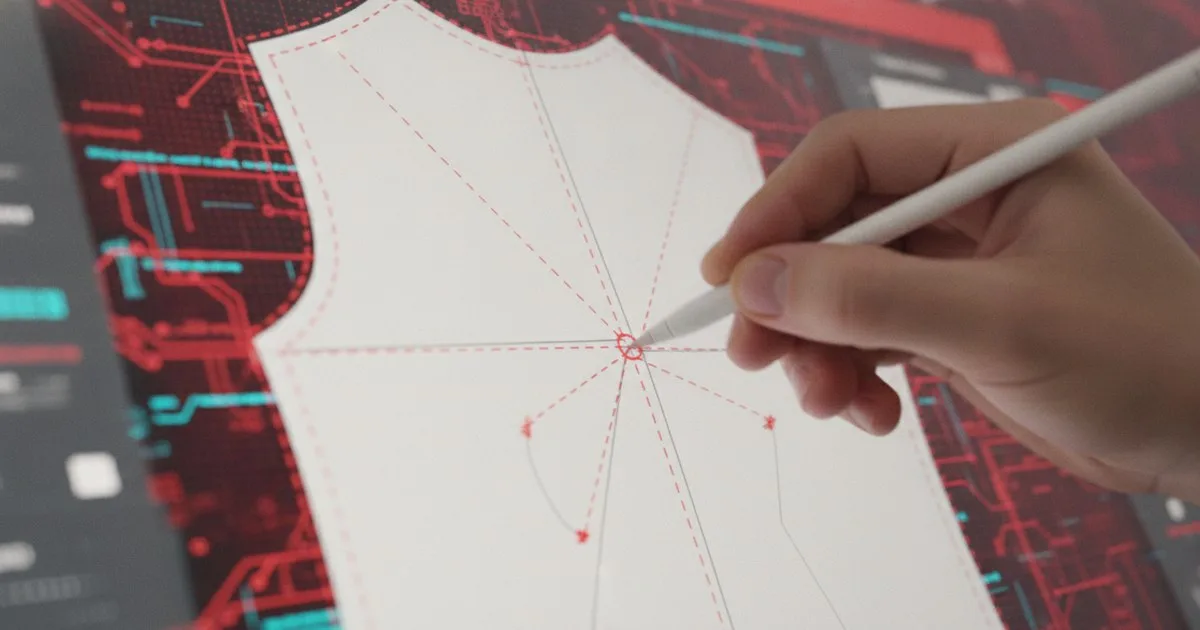
You are likely already using generative AI to accelerate your design cycle, but you may be building on a foundation of legal sand. Current intellectual property frameworks generally require human authorship for copyright protection, meaning that raw AI outputs could be ineligible for ownership and fall directly into the public domain. To safeguard your brand, you must navigate the complex intersection of training data transparency, prompt engineering, and the evolving global regulatory environment.
Key takeaways
- Raw AI-generated designs currently lack copyright protection in most jurisdictions because they do not meet the threshold of human authorship.
- The EU AI Act introduces mandatory transparency requirements for models, forcing disclosure of copyrighted training data.
- Brands face significant liability risks if AI-generated outputs are found to be "substantially similar" to existing protected works in the training set.
- Securing IP rights requires a documented "human-in-the-loop" process that demonstrates significant creative control over the final output.
Can I copyright a design created by generative AI?
The short answer is: not by the act of generation alone. Under current guidance from the US Copyright Office and similar bodies globally, copyright is reserved for works created by humans. If you provide a simple text prompt and the AI generates a complete sneaker design or textile pattern, that output is generally considered the product of the machine, not the prompter.
In our experience, the legal distinction hinges on the "modicum of creativity" provided by the person. If a designer uses AI as a tool—much like a digital brush in Photoshop—where they maintain control over every iteration, selection, and refinement, the resulting work may be protectable. However, the AI-generated portion itself remains uncopyrightable. This creates a "thin" copyright that only protects the specific arrangement or modifications made by the human, leaving the core AI-generated elements vulnerable to copying by competitors.
What are the primary IP risks for fashion brands using AI tools?
When you integrate generative AI into your workflow, you introduce three primary categories of risk: infringement, lack of protection, and data leakage.
Infringement Liability
Generative models are trained on billions of images, many of which are protected by copyright. If an AI tool produces a design that is strikingly similar to a signature print from a luxury house or a specific silhouette from a competitor, your brand could be held liable for copyright infringement. Even if the infringement was unintentional, the burden of proof lies on your ability to show that the design was an original creation. According to reports by BoF, several major retailers are already reviewing their design pipelines to ensure AI-generated concepts are sufficiently transformed by human designers before reaching production.
Lack of Enforceable Rights
If your best-selling print of the season was generated by an AI and you cannot prove significant human authorship, you may have no legal recourse if a fast-fashion competitor clones it. Without copyright, you cannot issue takedown notices or pursue litigation. This erodes the value of your intellectual property and makes it difficult to defend your brand’s unique aesthetic in a crowded market.
Data Leakage and Trade Secrets
Many public AI tools use the data you input to further train their models. If your design team uploads proprietary sketches, mood boards, or unreleased tech packs into a public generative tool, those assets could theoretically influence the outputs generated for other users, including your direct competitors. This effectively turns your trade secrets into public training data.
How does the EU AI Act change the way fashion companies procure technology?
The recently finalized EU AI Act represents the first comprehensive set of rules for artificial intelligence. For fashion brands operating in or selling to the European market, this regulation introduces strict transparency obligations.
General-purpose AI models must now provide a detailed summary of the content used for training. This is a critical development for procurement teams. When selecting a tool, you must now ask for documentation regarding the training set. If a tool was trained on pirated or non-consensual data, using it could expose your brand to regulatory fines and reputational damage. Furthermore, the Act requires that AI-generated content be labeled as such in certain contexts, which may impact how you present AI-assisted marketing campaigns to your customers. Industry analysts at Sourcing Journal have noted that this shift toward transparency will likely favor enterprise tools that use licensed or ethically sourced datasets.
Which tools offer the most legal protection for enterprise design teams?
Not all generative AI tools are created equal when it comes to IP security. Procurement and legal teams must distinguish between "black box" models and enterprise-grade solutions that offer indemnification.
For example, Adobe Firefly is designed to be commercially safe, as it is trained on Adobe Stock images, openly licensed content, and public domain content where the copyright has expired. Adobe also provides intellectual property indemnification for certain enterprise customers, which can mitigate the financial risk of potential infringement claims.
| AI Approach | Best For | IP Ownership Limits |
|---|---|---|
| Public LLMs/Image Generators | Rapid mood boarding and internal ideation | High risk; output is likely public domain; no data privacy. |
| Enterprise-Grade Tools | Commercial marketing and final prints | Lower risk; often includes IP indemnification; trained on licensed data. |
| Private Custom Models | Brand-specific silhouettes and archives | Best for protection; requires proprietary data; high cost of development. |
How can design teams document "human authorship"?
To maximize the chances of securing copyright for AI-assisted designs, your team must move beyond the "one-click" generation model. We recommend implementing a rigorous documentation process that records the creative journey.
- Iterative Prompting: Save the sequence of prompts used to guide the AI, showing how the designer steered the tool toward a specific vision.
- Hybrid Workflows: Start with a hand-drawn sketch, use AI to explore textures, and then manually refine the final pattern in a CAD environment.
- Selection and Arrangement: Document the specific choices made by the designer—why one AI-generated element was chosen over fifty others and how it was integrated into a larger collection.
- Version Control: Use PLM or digital asset management systems to timestamp every human intervention in the design process.
By treating the AI as a collaborator rather than a creator, you build a trail of evidence that supports your claim to the resulting intellectual property.
FAQ
Does a text prompt count as human authorship?
No. Current legal consensus suggests that providing a text prompt is akin to giving instructions to a commissioned artist. The person who gives the instructions does not own the copyright; the person (or in this case, the entity) that executes the creative expression does. Without manual refinement, the output remains uncopyrightable.
Can I be sued for designs my AI creates?
Yes. If the AI output is substantially similar to an existing copyrighted work, your brand can be held liable for infringement. This is true even if you were unaware that the training data contained the original work. Enterprise tools with IP indemnification are designed to mitigate this specific risk.
What does the EU AI Act require from fashion brands?
It requires brands to ensure the AI tools they use are transparent about their training data. You must verify that your vendors comply with copyright laws and, in some cases, you must disclose to consumers that an image or design was AI-generated.
Should I disclose AI use to my customers?
While not always legally required yet outside of specific EU AI Act provisions, transparency is becoming a brand value. Disclosure can prevent future PR crises if a design is later identified as AI-generated, and it helps manage expectations regarding the "uniqueness" of the product.