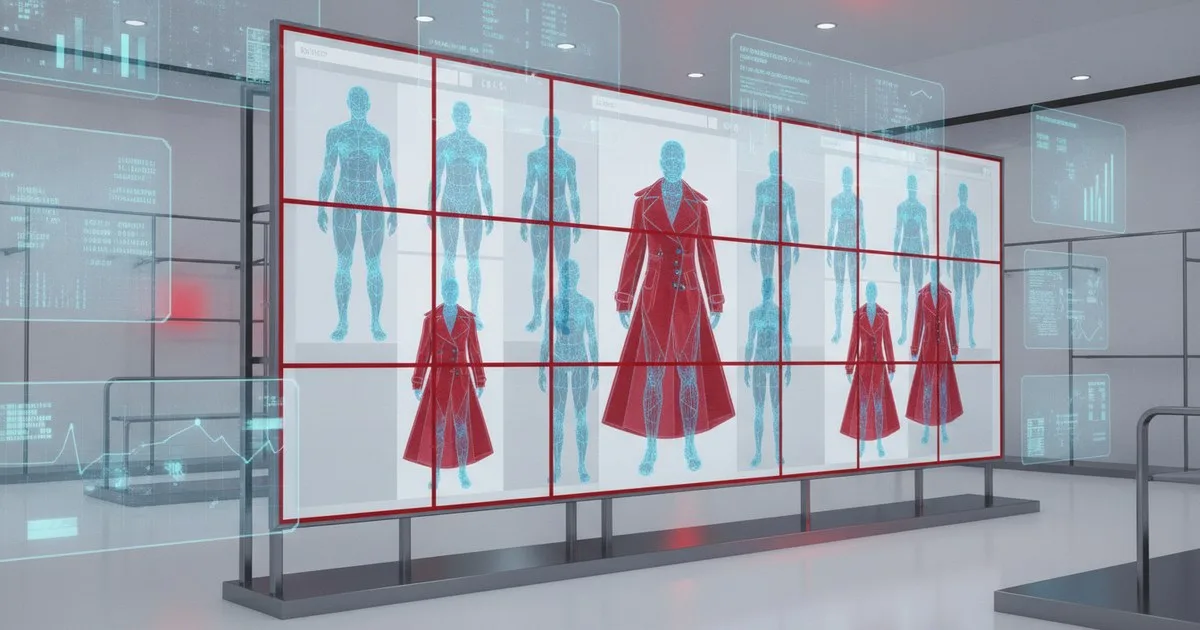
Virtual try-on technology is transitioning from a marketing gimmick to a core requirement for high-conversion e-commerce. You are seeing a shift where visual fidelity meets rigorous data privacy, as evidenced by a wave of new deployments and significant legal challenges regarding image manipulation. This quarter’s data confirms that while generative AI can boost engagement, the integration of precise fit data remains the primary driver for reducing return rates.
Key takeaways
- Generative AI models are now capable of draping garments across diverse body types with high accuracy in fabric behavior.
- Investment in AI-driven wellness and fit technology reached $3.6 billion in the first half of 2026.
- The integration of visual try-on with size recommendation engines is the most effective way to reduce online returns.
- Legal challenges regarding the misuse of generative AI for image manipulation are creating new compliance requirements for fashion brands.
Which virtual try-on tools are leading the market in 2026?
The current quarter has seen a consolidation of power among platforms that can handle complex garment draping at scale. Google Try-On has expanded its reach by utilizing advanced diffusion models that allow you to see how clothes look on a wide array of real models ranging from sizes XXS to 4XL. This technology does not just overlay a flat image; it simulates how the fabric stretches, folds, and clings to different silhouettes. For you as a buyer, this means a significant reduction in the "expectation gap" that often leads to customer dissatisfaction.
Simultaneously, Veesual has gained traction with its focus on the "Mix and Match" experience. Their platform allows users to choose their own model and then style multiple items together in a single view. This approach addresses the styling needs of the customer, moving beyond a single-item view to a full-outfit visualization. Retailers using these tools report that customers who engage with the virtual dressing room stay on the site three times longer than those who do not. The ability to switch models instantly helps you cater to a global audience with diverse body shapes and ethnicities without the need for thousands of physical photo shoots.
How do fit recommendation engines differ from visual try-on?
While visual tools focus on the aesthetic, fit technology focuses on the math. True Fit continues to dominate the data-driven recommendation space through its "Fashion Genome," which maps the fit preferences of millions of shoppers across thousands of brands. Instead of showing you a picture, it uses historical purchase and return data to tell you exactly which size you should buy. This quarter, the focus has been on connecting this data to the visual experience, ensuring that the model you see on screen is actually wearing the size the system recommends for you.
For brands that require even higher precision, 3DLOOK provides mobile body scanning technology. This tool allows your customers to take two photos of themselves to generate a highly accurate 3D body profile. This is particularly useful for made-to-measure brands or high-performance athletic wear where a 2D approximation is insufficient. The challenge for you remains the friction of the scanning process; however, the data shows that once a user has a saved profile, their lifetime value to the brand increases by over 40% due to the confidence in fit.
What are the latest funding trends for fashion and wellness AI?
Investment in the sector is rebounding, but the focus has shifted away from hardware toward software that leverages deep data sets. According to reports from August 12, 2026, startup investment in fitness and wellness categories—which overlap significantly with fashion-fit technology—totaled more than $3.6 billion in the first half of the year. This puts 2026 on a trajectory to be a third higher than the previous year. Investors are no longer interested in simple "treadmill" companies; they want platforms that use AI to personalize the user experience.
In the broader AI landscape, massive capital is still flowing into infrastructure. On August 14, 2026, a major data and AI infrastructure firm announced a $5 billion funding round, highlighting the immense resources required to power the generative models used in fashion. Furthermore, the regulatory environment is tightening. On August 14, 2026, the California DMV began officially permitting self-driving truck tests on public highways under updated rules. This move toward formalizing AI testing in the physical world mirrors the increasing pressure on fashion-tech companies to prove the safety and accuracy of their algorithms before wide-scale deployment.
What security risks should retail buyers consider?
As you integrate more generative AI into your customer experience, security must be a top priority. A significant legal case emerged on August 15, 2026, where a lawsuit was filed against a prominent AI developer. The case involves allegations that a generative chatbot was used to manipulate childhood photos into explicit imagery. This highlights a critical vulnerability: any tool that allows users to upload photos for virtual try-on can be exploited if proper guardrails are not in place.
| Tool | Primary Function | Best For | Technical Constraint |
|---|---|---|---|
| Google Try-On | Generative draping | High-fidelity visual search | Limited to supported retailers |
| Veesual | Mix-and-match styling | Multi-item outfit visualization | Requires high-quality flat lays |
| True Fit | Data-driven sizing | Reducing size-related returns | No visual representation of garment |
| 3DLOOK | Body scanning | Custom tailoring and precise fit | Requires user to take photos |
For retail buyers, this means you must demand "tenant-isolated" environments where user data is never used to train public models. You should also look for vendors that provide automated content moderation to prevent the misuse of your platform's image-generation capabilities. The risk of brand damage from a single high-profile misuse of your try-on tool far outweighs the short-term conversion gains if the technology is not properly secured.
How does online fit technology impact return rates?
The primary metric for success this quarter remains the return rate. Brands that have successfully paired visual try-on with fit recommendation data are seeing the best results. When a customer can see the garment on a body like theirs and receive a data-backed size recommendation, the likelihood of a "bracket purchase" (buying two sizes to return one) drops by 25%. You should evaluate vendors based on their ability to integrate these two distinct types of technology into a single, seamless user flow.
FAQ
How much does virtual try-on increase conversion?
Data from this quarter suggests that retailers implementing high-fidelity visual try-on see an average conversion lift of 15% to 20%. This is highest in categories like denim and dresses, where visual draping and fit are most critical to the purchasing decision.
Is my customer data safe with virtual try-on vendors?
Safety depends on the vendor's architecture. You must ensure they use private, isolated environments. Recent lawsuits from August 2026 regarding image manipulation highlight the need for robust security protocols and strict limitations on how user-uploaded photos are processed and stored.
Can virtual try-on replace physical samples?
While it significantly reduces the need for physical samples in the marketing phase, it does not yet replace the need for physical prototypes in production. It is currently a tool for consumer confidence and styling rather than a replacement for technical garment construction.
What is the cost of implementing these tools?
Implementation costs vary widely. Enterprise-level tools often require a setup fee for model training and a monthly subscription based on traffic or the number of SKUs. Smaller brands may find more affordable, template-based solutions, though these offer less accuracy in fabric simulation.
Which technology is better: body scanning or data-driven fit?
Body scanning is superior for precision and custom-fit products. Data-driven fit recommendation is better for high-volume, ready-to-wear retail because it has lower user friction. Most successful large-scale retailers currently favor data-driven models for their ease of use.
Further reading
- Woman claims her stepfather used Grok to transform childhood photo into explicit imagery
- The Week’s 10 Biggest Funding Rounds
- Sector Snapshot: Fitness Startup Funding Is Rebounding
- Self-driving trucks are officially testing on California highways
- Veesual
- 3DLOOK
- True Fit
- Google Try-On