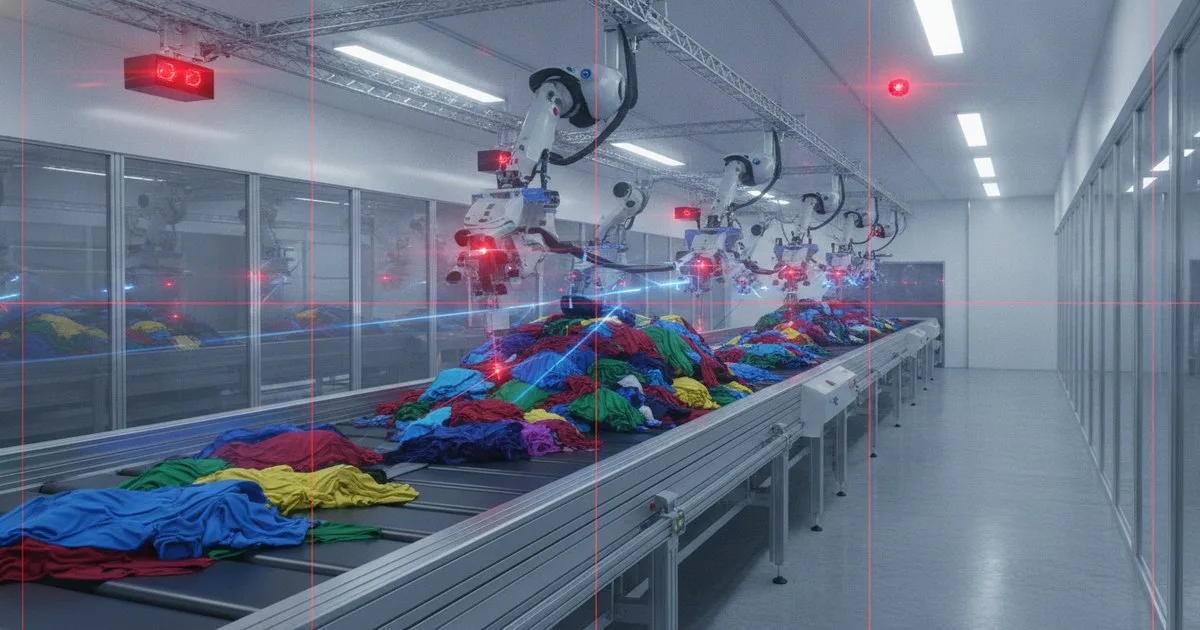
On July 23, 2026, Berlin-based startup reverse.fashion closed a seven-figure pre-seed investment round led by High-Tech Gründerfonds (HTGF) to scale its AI-driven textile sorting technology. This capital injection targets the primary bottleneck in the circular economy: the inability of current infrastructure to accurately identify and sort post-consumer garments at industrial speeds. By automating fiber identification, the platform enables high-purity recycling streams that were previously impossible with manual labor.
Key takeaways
- Infrastructure Pivot: Investors are shifting focus from consumer-facing resale apps to the "hard-tech" infrastructure required for industrial-scale recycling.
- HTGF Backing: The seven-figure round led by High-Tech Gründerfonds (HTGF) validates the technical viability of AI-based fiber identification.
- Strategic Alliances: Major tech players like Google and eBay are doubling down on digital wardrobe data to feed the circular loop.
- Regulatory Pressure: The rise of AI sorting tools is a direct response to tightening EU textile waste regulations and EPR (Extended Producer Responsibility) schemes.
Weekly News Roundup: Circularity and AI Hits the Mainstream
August 16, 2026: Luxury asset tracking reaches new heights New reports on the valuation of high-profile collections, such as the $2.1 million watch portfolio of Georgina Rodríguez, highlight the increasing professionalization of luxury asset tracking. While seemingly centered on celebrity culture, the ability to track and authenticate high-value items is a precursor to the digital product passports required for a transparent secondary market. As luxury items are increasingly viewed as financial assets, the demand for precise digital records and authentication tech is surging across the resale sector.
August 14, 2026: Whering secures $7m seed from Google AI and eBay Digital wardrobe platform Whering has raised $7 million in a seed round backed by the Google AI Futures Fund and eBay Ventures. CEO Bianca Rangecroft confirmed that the capital will be used to enhance AI capabilities, allowing the platform to better predict consumer behavior and integrate directly with resale marketplaces. This investment signals that major tech and e-commerce entities see digital wardrobes as the critical data layer for the circular economy, providing the "input" data that sorting facilities like reverse.fashion will eventually process.
July 23, 2026: reverse.fashion closes seven-figure pre-seed led by HTGF In a move that underscores the growing appetite for circular infrastructure, reverse.fashion secured a seven-figure investment to deploy its AI-driven textile sorting platform. The Berlin-based startup uses computer vision and machine learning to categorize garments by material composition, condition, and brand. This automation is designed to replace the slow and error-prone manual sorting processes that currently prevent textile-to-textile recycling from reaching profitability.
What is the significance of the reverse.fashion pre-seed round?
You need to look at the "hard-tech" nature of this investment to understand its impact. For years, fashion-tech funding—as tracked by Crunchbase—was dominated by marketplaces and rental platforms. However, those platforms are only as good as the volume of quality goods they can process. By securing seven figures from a technology-focused investor like HTGF, reverse.fashion is proving that the industry's focus is moving "upstream."
This round signals that the market is ready to fund the messy, physical reality of textile waste. You are seeing a transition from software-only solutions to integrated hardware-software stacks that can handle thousands of garments per hour. For sustainability teams, this means the promise of "circularity" is finally getting the industrial backbone it needs to move beyond pilot projects.
How does AI textile sorting improve circularity in fashion?
The current state of textile recycling is hindered by a lack of data. When a garment reaches a sorting center, a human worker often has only seconds to identify the fiber blend by touching the fabric or reading a (likely faded) care label. This leads to contamination in recycling streams, which ruins the quality of the recycled yarn. According to research by the Ellen MacArthur Foundation, less than 1% of clothing is recycled into new clothing, largely due to these sorting inefficiencies.
AI textile sorting changes the math by:
- Spectral Analysis: Using sensors to detect exact fiber percentages (e.g., 60% cotton, 40% polyester) regardless of what the label says.
- Condition Grading: Automatically identifying stains, tears, or pilling that determine whether an item should be resold, repaired, or recycled.
- Brand Identification: Recognizing specific brand patterns and construction methods to facilitate targeted take-back programs.
Why are major tech players like Google and eBay investing in digital wardrobes?
The Whering deal is a clear indicator that the data generated by your closet is becoming a valuable commodity. When Google and eBay invest in a digital wardrobe, they aren't just looking at a styling app; they are looking at a predictive engine for the secondary market. If a platform knows exactly what you own, it can prompt you to list an item on eBay the moment its resale value peaks or suggest a repair service when the item reaches a certain age.
This "digital twin" of the consumer's closet provides the metadata that industrial sorters need. When you eventually discard a garment, its digital record can follow it to a facility using reverse.fashion's technology, making the sorting process instantaneous and 100% accurate. This is the "connected circularity" model that industry publications like FashionUnited report is becoming the gold standard for enterprise sustainability strategies.
Comparison: Sorting and Tracking Technologies
| Technology | Best For | Limits |
|---|---|---|
| Manual Sorting | High-value vintage and unique items | Slow, expensive, high error rate in fiber identification |
| AI Sorting (reverse.fashion) | Industrial-scale recycling and high-volume resale | Requires significant initial facility investment |
| Digital Wardrobes (Whering) | Consumer engagement and data collection | Relies on user behavior and manual data entry |
| Digital Product Passports | End-to-end traceability and regulatory compliance | Requires brand-wide adoption at the manufacturing stage |
How does luxury asset tracking impact the broader circular economy?
You might think a $2 million watch collection is far removed from textile recycling, but the underlying technology is the same. The push for transparency in high-value luxury assets is driving the development of authentication and tracking tools that will eventually be commoditized for the mass market. As reported by Just Style, the integration of AI into these tracking systems allows for a more resilient and trustworthy resale market. When the technology exists to track a six-figure watch through five owners, it creates the blueprint for tracking a $100 jacket through its entire lifecycle, ensuring it never hits a landfill.
FAQ
What did reverse.fashion announce?
On July 23, 2026, the Berlin-based AI startup announced a seven-figure pre-seed funding round led by High-Tech Gründerfonds (HTGF). The capital is earmarked for developing and scaling their AI-driven platform that automates the sorting of used textiles by material, brand, and condition to facilitate industrial recycling.
Who is funding textile AI startups?
Recent rounds show a mix of deep-tech VCs like HTGF and corporate venture arms like eBay Ventures and the Google AI Futures Fund. This mix indicates that both technical experts and marketplace operators see AI as the essential infrastructure for the future of the fashion industry.
Why is sorting the bottleneck for circularity?
Currently, most textile sorting is manual, making it too slow and inaccurate for high-volume recycling. Without precise fiber identification, recyclers cannot produce high-quality new yarn, which keeps the industry stuck in a "downcycling" loop where clothes are turned into insulation or rags instead of new garments.
What is the Whering funding used for?
The $7 million seed round will be used to integrate more advanced AI into the Whering platform. This helps the app better identify items in a user's closet and connect them to circular services like resale, repair, and recycling, creating a seamless data loop for the consumer.
How do EU regulations affect this funding?
New EU waste directives and Extended Producer Responsibility (EPR) schemes are forcing brands to take responsibility for the end-of-life of their products. This regulatory pressure is a massive tailwind for startups like reverse.fashion, as brands are now legally and financially incentivized to find efficient sorting and recycling solutions.
Further reading
- Textile Circularity Needs Smart Sorting: reverse.fashion Secures Pre-Seed Funding
- Whering CEO on why Google AI and eBay are betting on digital wardrobes
- Startup Gets VC Funding To Bring AI to the Circular Economy